






From Mentor to Most Admired: Dr. Jogadia’s Journey of Building Bridges Across Continents
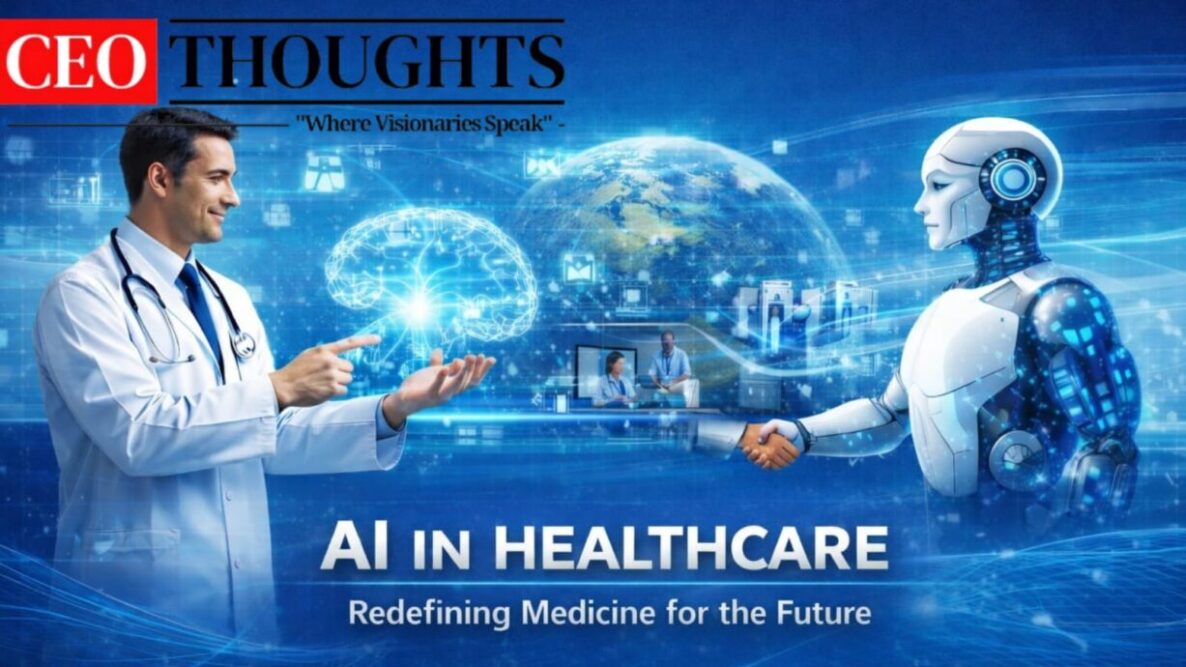
Artificial Intelligence in Healthcare: Redefining Medicine for the Future
Artificial intelligence (AI) is rapidly reshaping healthcare and has emerged as one of the most
transformative forces in modern medicine. Despite significant advances in medical science, nearly 4.5 billion people worldwide still lack access to basic primary healthcare. Shortages of healthcare professionals, rising treatment costs, and unequal distribution of medical resources continue to strain health systems, particularly in developing countries. In this context, AI offers a powerful opportunity to improve healthcare delivery, efficiency, and equity. Today, AI is no longer a distant futuristic idea confined to research laboratories. It is already being integrated into hospitals, clinics, and laboratories to support doctors, enhance diagnostics, and improve patient outcomes. Rather than replacing healthcare professionals, AI acts as a supportive tool—augmenting human expertise and allowing clinicians to focus more on patient-centered care.
 AI is transforming healthcare systems by making diagnosis, treatment, research, and patient
management faster and more accurate. By analyzing vast volumes of medical data, AI helps
clinicians identify patterns that are difficult to detect through traditional methods. This reduces clinical workload, minimizes human error, and improves overall efficiency.
A notable example of this transformation is the development of AI-powered hospitals, such as the world’s first AI hospital in China. These initiatives demonstrate how AI can support diagnosis, treatment planning, and patient monitoring at scale. Such models are particularly valuable in regions facing shortages of trained healthcare professionals and increasing patient demand.

Medical diagnosis is one of the most impactful areas where AI is making a difference. AI systems can detect diseases at very early stages—sometimes even before patients notice symptoms. Early
identification enables timely intervention and significantly improves treatment outcomes.
Advanced AI tools can analyze X-rays, CT scans, MRIs, and ultrasounds within seconds, providing consistent and reliable assessments. Since diagnostic errors can occur due to fatigue, time pressure, or complexity, AI serves as a second layer of support, helping doctors make more accurate and confident decisions.
AI is also playing a crucial role in treatment planning and personalized medicine. By analyzing a patient’s genomic profile, medical history, and lifestyle data, AI helps clinicians choose the right treatment for the right patient at the right time. This personalized approach improves treatment effectiveness and reduces unnecessary complications.
Additionally, AI can predict potential side effects and assess treatment-related risks, enabling safer and more informed clinical decisions. Early detection and precise planning often lead to less invasive and more cost-effective treatment options, benefiting both patients and healthcare systems.
AI-assisted robotic surgery is increasingly being adopted in large and advanced hospitals. These systems operate under the supervision of skilled surgeons, enhancing precision without replacing human expertise. Robotic-assisted procedures allow smaller incisions, reduced blood loss, faster recovery, and shorter hospital stays. Enhanced visualization through high-definition and 3D imaging enables surgeons to clearly view complex anatomical structures, improving surgical accuracy and patient safety. AI-driven robotic surgery represents a major step forward in modern surgical care.

Drug discovery has traditionally been a long, expensive, and uncertain process, often taking 10–15 years to develop a single successful drug. AI is revolutionizing this field by accelerating research and reducing costs. It is now used in target identification, drug design, compound screening, lead optimization, preclinical testing, and clinical trial optimization.
By rapidly analyzing large datasets and predicting drug–target interactions, AI reduces trial-and-error approaches and improves the success rate of new therapies. This has the potential to make life saving medicines available faster and more affordably

In countries like India, rural healthcare remains a major challenge due to limited infrastructure and lack of specialists. AI and telemedicine together offer a promising solution. AI-powered telemedicine platforms allow patients in remote areas to consult doctors without traveling long distances, reducing both time and cost. Virtual assistants and chatbots provide medical guidance, appointment support, medication reminders, and follow-up care. AI can also analyze speech, text, and behavioral patterns to support early identification of mental health conditions such as depression, anxiety, and stress. These technologies help bridge the gap between rural and urban healthcare services
Despite its many benefits, AI also presents important challenges. Data privacy and security are major concerns, as AI systems require access to sensitive medical information. Risks of data breaches, hacking, and unauthorized access must be addressed through strong cybersecurity frameworks. Bias in AI models is another critical issue. Many systems are trained primarily on data from European, North American, and Australian populations, which may lead to inaccurate results for certain ethnic, gender, or age groups. Such bias can result in misdiagnosis and unequal treatment. Regulatory and legal challenges further complicate AI adoption. The lack of global standardization, unclear liability, and ethical concerns need to be resolved. Additionally, the high cost of AI technologies raises concerns that benefits may remain limited to well-funded healthcare systems, widening the digital divide.
The future of AI in healthcare lies in prediction and prevention rather than treatment alone. AI-driven systems will increasingly identify disease risks before symptoms appear, enabling preventive care and early intervention. Integration with wearable devices and digital health platforms will allow continuous monitoring and real-time health insights.
However, the most effective healthcare systems will be those that balance AI’s analytical power with human empathy, ethical judgment, and clinical experience
Artificial intelligence is not a threat to healthcare—it is an opportunity for transformation. AI cannot replace doctors, but it is empowering them to become more precise, informed, and effective in their practice. By supporting medical professionals and expanding access to quality care, AI has the potential to make healthcare more accurate, affordable, and accessible for all. When implemented responsibly, AI can help build a stronger, more equitable, and patient-centered healthcare system.

















Related Content